


Case study: PBIF Listening Sessions & Open Call Co-Design
Envisioning human-centered, tech-enabled public benefits systems
Public benefits systems are under strain and H.R. 1 has created further barriers. The Public Benefit Innovation Fund (PBIF) – with the support of AARP Foundation – partnered with CivicMakers to conduct listening sessions with caseworkers, state officials, AI advisors, advocates, and more to inform the funding strategy for their Spring 2026 Open Call.
[See the awarded projects here]

Listen
Public benefits systems have historically suffered from compliance coming before care. Many factors have contributed to this, including legacy technology that stifles the ability for public benefits systems, and those who administer them, to function in a human-centered way. The passage of the One Big Beautiful Bill Act (referred to as H.R. 1) sows even more uncertainty around benefits eligibility and introduces further complexity in how benefits are administered.
At the same time, PBIF, a funding arm of Center for Civic Futures, has awarded millions of dollars supporting artificial intelligence (AI) projects poised to strengthen how public services are delivered nationwide.
“This summer’s highly competitive open call received more than 400 applications from 45 states, reflecting both urgency and momentum in the field.”
– Center for Civic Futures and partners commit $8.5M for AI solutions that improve safety net program delivery (December 9, 2025)
Meeting the Moment
Growing pressures on the social safety net and rapidly evolving technology have created a complicated landscape for states to navigate. To help them meet the moment, PBIF wanted its 2026 Spring Open Call to address challenges that remained the most pressing to stakeholders within these systems, while inspiring creative uses of emerging tech.
Internal Engagement
Before looking forward to future funding opportunities, we first had to ensure we built on the insights gained from the last Open Call. Through a team retrospective session and a follow-up survey, we invited PBIF staff and key advisors to reflect on what worked well in the Summer 2025 Open Call and what could be improved.
“We just got 400 proposals – engaged thousands of people and raised millions of new money – it is our job to learn, iterate and improve.” – PBIF Team Member
The retrospective surfaced several areas of alignment and ongoing questions that we could explore further. In particular, we learned:
- The portfolio of projects from the last call were high-quality and clearly demonstrated a commitment to collaboration and knowledge-sharing.
- PBIF already had a strong network to engage for responses which they saw branch further as people shared the opportunity. This revealed a lot of “organic ecosystem excitement,” as one staff member phrased it.
- The last open call focused on casting a wide net and encouraging a diversity of responses. This offered creative liberty to the respondents; however, without a narrow focus, a lower percentage of the responses tackled hard or “un-sexy” challenges of benefits service delivery, like improving back-end infrastructure.
From these engagements, we also got to see PBIF’s nuanced view of innovation. Despite PBIF’s focus on emerging tech, to them, innovation isn’t about the latest and greatest in technology. Instead, their focus was more on how technology could help “raise the floor” (improving the baseline) and “raise the ceiling” (envisioning new futures) for service delivery. Where are there opportunities for new tools and approaches to address those unsexy issues; and where are there opportunities for new tools and approaches to fully re-imagine systems to be adaptive and client-centered?
Listening Sessions
In order to explore both opportunities to raise the floor and raise the ceiling, we would need to connect with people who could share first-hand insight into what’s needed and technical expertise into what’s possible.
From January – March 2026, our team conducted 19 listening sessions to better explore this landscape. We worked closely with the PBIF project team, and their broad network, to speak with:
- State- and department-level leadership who could identify ongoing efforts to improve benefits service delivery
- Case workers who could share current challenges in public-facing services, and weigh in on tools that would help in their day-to-day work with clients
- Older adult advocacy groups to validate specific needs for a population which can be particularly marginalized by tech-first solutions
- State-level AI Advisors who could describe shared infrastructure / investments that would unlock progress for states
- People working in and around civic tech who could provide tactical use cases for emerging technology in H.R. 1 response and surface any gaps and blockers
- Civil servants in related areas such as child welfare and labor to identify shared challenges and opportunities in other fields of public service
As important as it was to hear from a range of perspectives, it was also important to start bridging these areas of expertise. We drafted a simple visual that would help people see where they were positioned and where they could provide the most insight. We called this visual a map of different Service Layers.
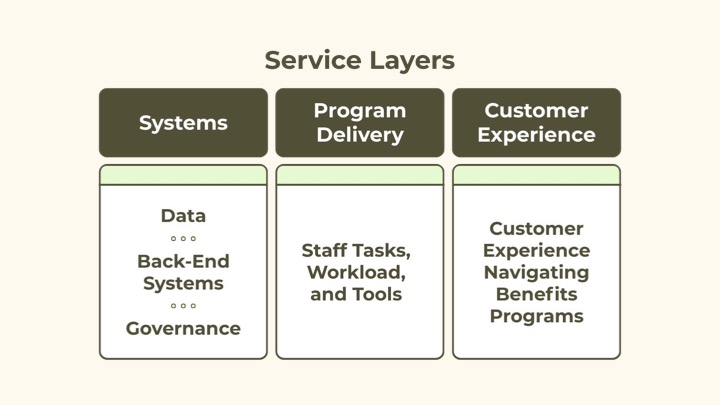
Our team developed and tested this visual in our preliminary interviews to validate our interpretation of the landscape. We continued referencing it throughout the Listening Sessions since it created a simple anchor point for what was a substantial topic. We also found that it helped put some participants at ease because they knew they could participate in this conversation without being AI experts or without being in the weeds of benefits services.
“I don’t want to overstate my level of familiarity or involvement in the intersection of AI and public benefits. I’ll [speak to] my background running a statewide ombuds program for older adults and people with disabilities who need long-term care services…” – Interviewee, Older Adults Advocate
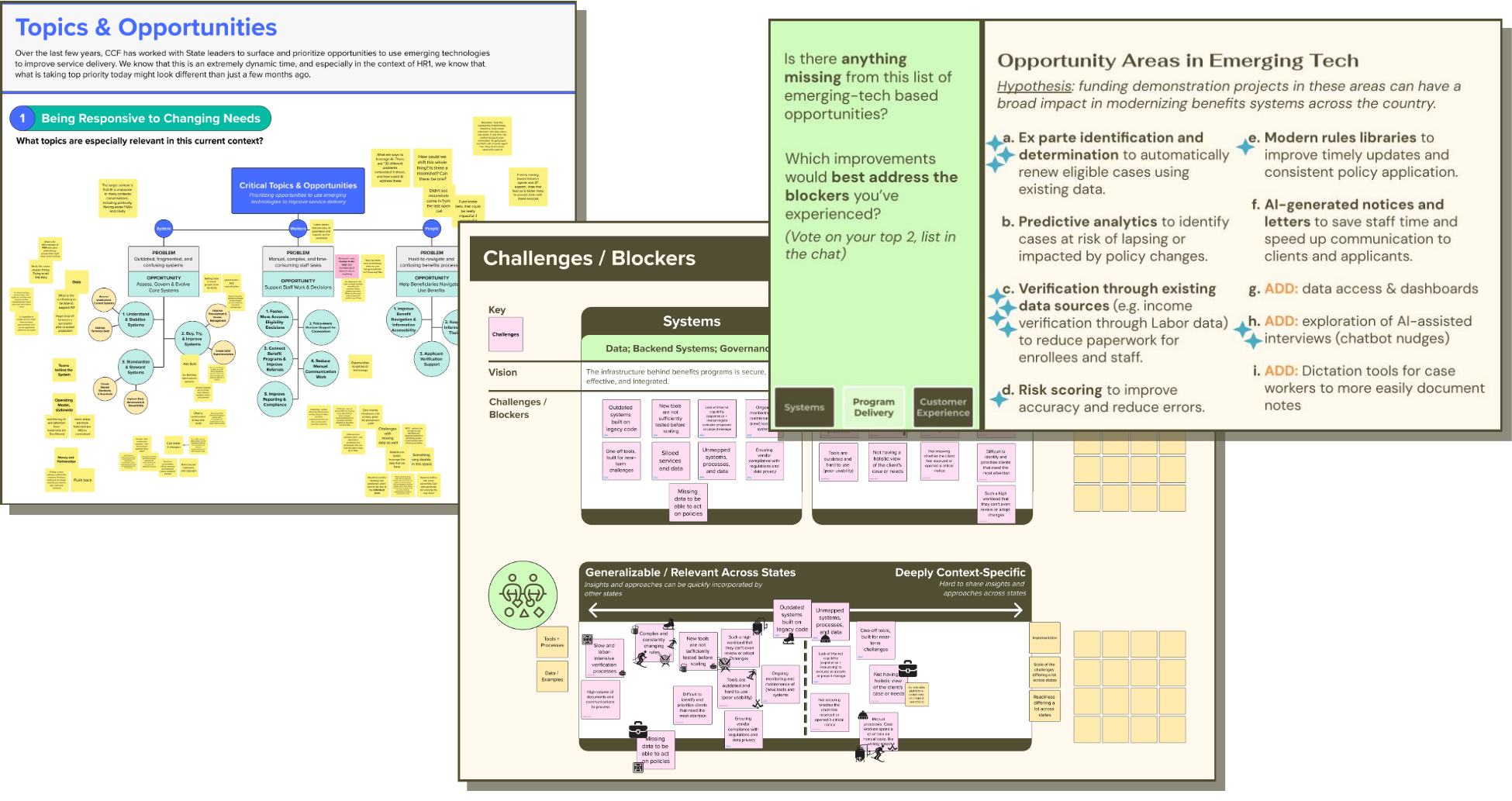
Over the course of our engagements, we connected with people who represented these different service layers, as well as people that straddled multiple layers.

Learn
Through the listening sessions, we heard of existing holes of the social safety net that are widening with the implementation of H.R. 1. Some of the longstanding challenges that rose to the top include:
- Administrative Burden & Documentation
- State Capacity & Change Management
- Data Access, Use & Analytics
- Vendor Procurement & Accountability
- Client Experience & Navigation
Administrative Burden & Documentation
Case workers are called to this work from a desire to help people, but much of their time goes to processing paperwork, transcribing notes, navigating shifting policies, and verifying information other government agencies have collected elsewhere. This means case workers are regularly encountering people who have already been traumatized by systems, at vulnerable times in their lives, having to be subjected to the same, invasive intakes processes multiple times. H.R. 1 is making this harder, adding new information categories to verify, documentation to collect, and eligibility logic to apply – all on top of their existing work.
“So much more could be accomplished if the caseworkers could actually focus on what is really needed, like emotional support, mental health, assisting in finding jobs and housing – rather than the mounds of paperwork and system navigation.” – Interviewee, Case Worker
State Capacity & Change Management
Many states are still running on decades-old mainframe systems that are expensive to maintain, difficult to update, and weren’t built to support modern tools. Modernizing those systems is important foundational work, but it’s often slow, expensive, and needs expertise most states don’t have in-house.
Making these changes also require engagement with public-facing staff, and the capacity to monitor and adapt a transition effort. These kinds of collaborative and iterative approaches can be challenging for states to sustain and invest money and capacity in.
“When we build prototypes, even if we get this into development, who’s managing this? What about maintenance and oversight? Those challenges existed before AI, those challenges are happening at every technical side of the solution” – Interviewee, State AI Advisor
Data Access, Use & Analytics
States collect lots of data about the people they serve and rarely use it to reach eligible people, catch problems early, or improve how programs work. H.R. 1 is adding pressure to an already strained situation: states now have to verify new categories of information and report new outcome metrics, often without the systems or procedures to do either well.
“You already have my info…can’t you just figure out a way to use what you already have? I don’t want to have to re-give my info.” – Focus Group Participant, Older Adult Advocate
Vendor Procurement & Accountability
States are being pitched solutions faster than they can evaluate them. And when new tools are implemented, many states don’t have the in-house expertise to measure performance. Not being able to discern what’s working and what benchmarks to aim towards, it’s difficult to steward and monitor these systems to public sector standards.
“Sometimes governments get [tools] that are too general. Having more purpose-built systems would be helpful. [Selecting] the right size of the software for the problem then speeding up the approval process or centralizing the standards around that” – Focus Group Participant; Civic Tech Consultant
Client Experience & Navigation
Accessing benefits is confusing, easy to get wrong, and a single mistake can mean losing coverage. Even when people make it through the application process, there may not be a good way for them to keep track of what’s happening with their case or know what they might need to do next.
“People accidentally put today’s date as their birthday all the time in applications. What if they do that and the AI model says you can’t have Medicaid because you’re zero years old?” – Focus Group Participant, Older Adult Advocate
In this context, emerging technologies are being presented as powerful tools to tackle complexity and get to solutions faster. There is growing interest in using these tools to not only address current challenges but leapfrog to designing integrated and client-centered systems.
There’s very real potential in this moment. States want to be able to go through this journey together – learning from each other and sharing what they’ve learned and built, in return.

Make
After facilitating the listening sessions and distilling core themes, we presented considerations for the next Open Call to internal stakeholders at Center for Civic Futures. We proposed strategic investment directions that could meaningfully tackle the challenges that are experienced at different service layers. We then mapped the projects from the last Open Call under each one, to highlight where there might be opportunities to differentiate this next funded cohort.
PBIF launched their Spring 2026 Open Call in April, 2026. This Open Call focused on projects that experiment with novel applications of emerging technologies to solve persistent problems in public benefit delivery:
- Improving backend processes to enable caseworkers to focus on people, not administrative tasks.
- Using data effectively to comprehensively and simply connect people to services.
- Modernizing tech infrastructure to enable the systems of the future.
To close out this effort, we prepared a detailed final report that gives greater depth to the themes and further explores PBIF’s position and opportunities to continue supporting states across the country.
Be sure to check out the awarded projects here: Center for Civic Futures Awards $11 Million to Tackle the Toughest Barriers in Safety Net Delivery with AI

“I appreciated the depth, thoughtfulness, and creativity CivicMakers poured into the research process. We were able to refine down a pathway for our next Open Call, flowing directly from the focus areas their team sourced and defined from Listening Sessions. I’m so excited that we now have this clear and strong documentation as a foundation as we refine the future strategy of our program.”
Eleanor Davis Director of the Public Benefit Innovation Fund, Center for Civic Futures