


Case study: Mobile Benefits Center with SF Human Services Agency
Bringing food, cash, job, and healthcare assistance directly to San Francisco neighborhoods
CivicMakers partnered with the San Francisco Human Services Agency (SFHSA) and the San Francisco-Marin Food Bank (SFMFB) to co-design a Mobile Benefits Center pilot program. We engaged community members, SFHSA staff members, and community-based organizations to shape and test core elements of this new program.

Listen
The goal of the Mobile Benefits Center is to reduce food insecurity and barriers to accessing benefits that can improve the health, nutrition, and general well-being of low-income communities. Working closely with SFHSA and SFMFB, we listened to residents and their range of experiences accessing benefits like CalFresh (SNAP), Medi-Cal, CalWORKs, and County Adult Assistance Programs (CAAP).
To ensure we connected with residents who are experiencing food insecurity and underserved by benefits programs, we referenced SFHSA-collected data on benefits enrollment rates across San Francisco neighborhoods and demographics. Our research team then coordinated with local partners to conduct intercept surveys at food pantry events and an off-site SFHSA office operated out of the Chinese Newcomers Service Center in San Francisco’s Chinatown.
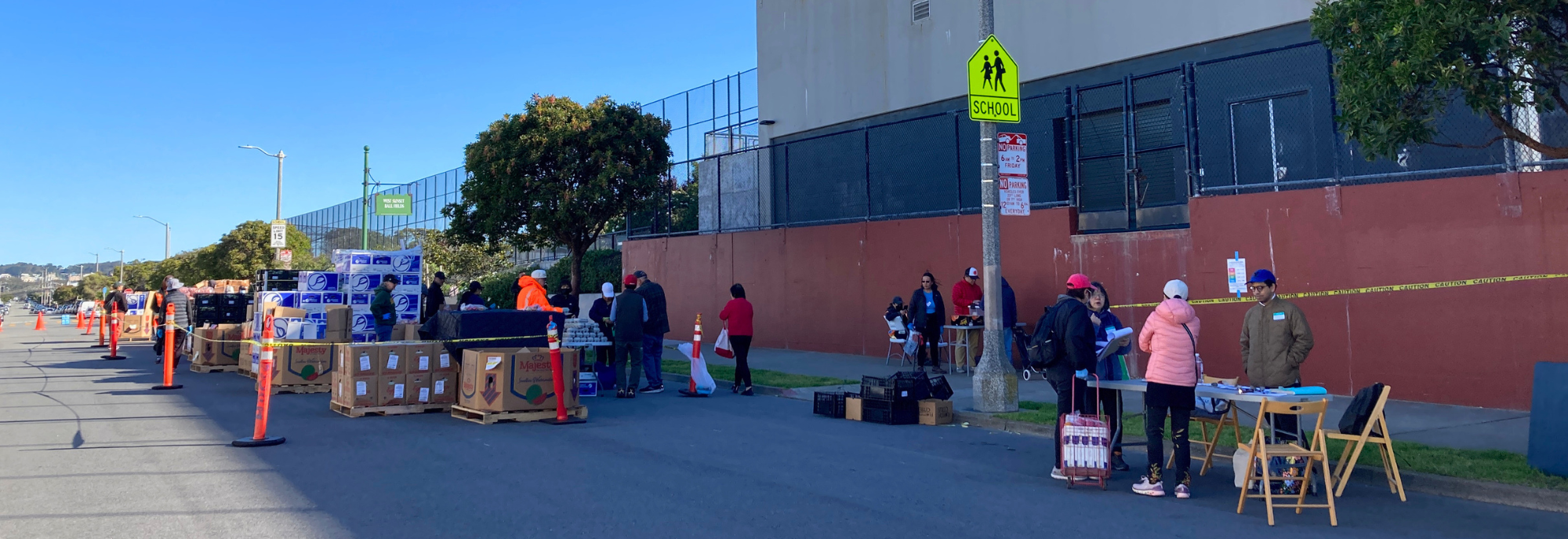
Alongside our translation partners at SFHSA and SFMFB, we conducted 39 interviews with residents across four neighborhoods (Chinatown, Sunset, Excelsior, Mission), in English, Spanish, and Chinese. Throughout the engagement we prioritized building trust, meeting participants where they were, and centering their voices to shape the Mobile Benefits Center experience.
We also conducted preliminary interviews with staff members from SFHSA and SFMFB to understand the challenges and opportunities from the outreach and service-delivery perspective.

Learn
From our conversations with residents, service providers, and staff, we learned that personalized, in-person support is critical to building trust and supporting successful enrollment. Many participants shared that speaking directly with an eligibility worker helped them feel confident during the application process.
“[When speaking with an SFHSA Staff Member] I can ask questions and they are patient and take their time with me. They’re warm and kind. They help me.”
– Community Member
We also heard that submitting personal information online can feel risky for some, and that locating the Mobile Benefits Center at trusted community sites would make it more trustworthy.
“When online, I’m unsure if it’s real. If it was in person, that would be better.”
– Community Member
To contextualize what we heard, and what it means for the program design, we held two ideation sessions:
- In the first session, we convened 14 HSA staff members from a range of teams (e.g. CAAP, CalWORKs, CalFresh/Medi-Cal, PSO, Fiscal) and roles (e.g. Eligibility Worker, Program Supervisor, Sr. Account Clerk) to validate findings and translate insights into program design recommendations. This session helped us to identify what program elements were must-haves versus nice-to-haves.
- In the second session, we hosted 12 external partners – professionals in the areas of outreach, social services, referral and benefits assistance from several city departments and community-based organizations – to provide insight into both receiving and providing services. The session surfaced practical considerations related to outreach, service delivery, and client experience.
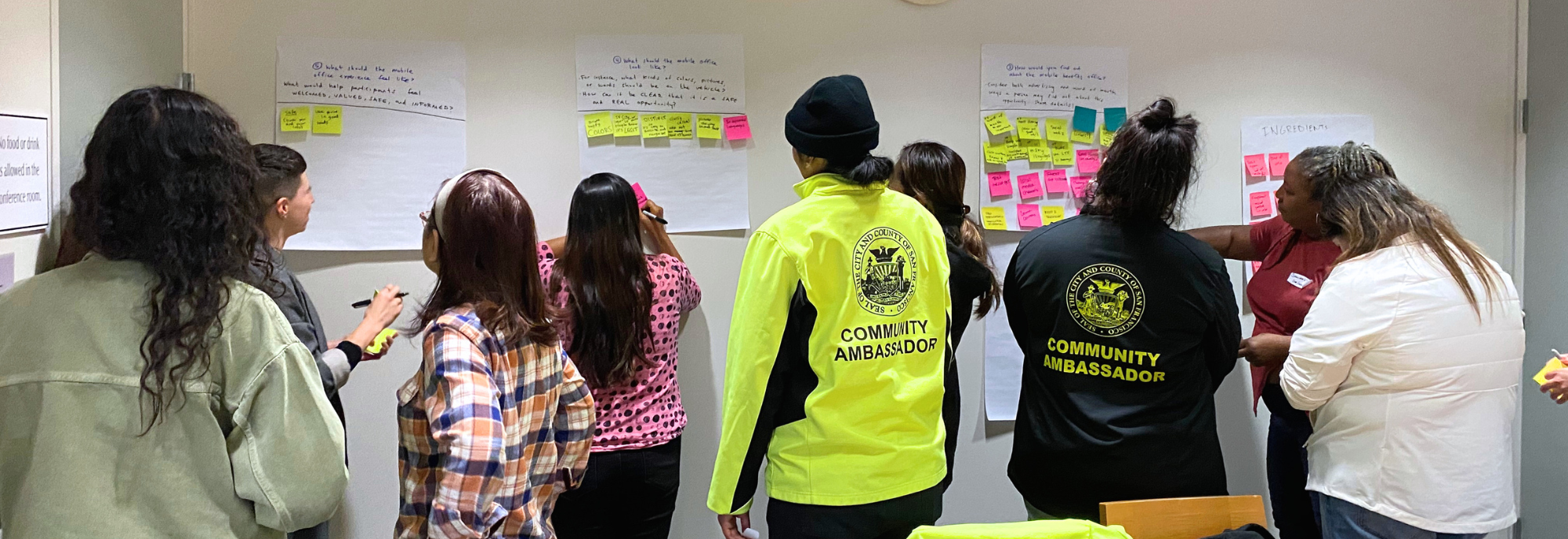
Combined, these insights helped define key design principles for the program and ideas to further explore during prototyping. 
Make
Throughout this project, the vehicle was actively being procured and built but was not yet on hand to be tested. Even so, this gave us the space to shape other elements of the program. We designed and tested several prototypes to gradually build out the program, with the input of residents, staff and service providers. These prototypes took many different shapes, but they generally fell under three categories:
- Prototypes of Internal Program Artifacts
- Prototypes of Outreach & Design Elements
- Prototypes of Service Delivery
Prototypes of Internal Program Artifacts
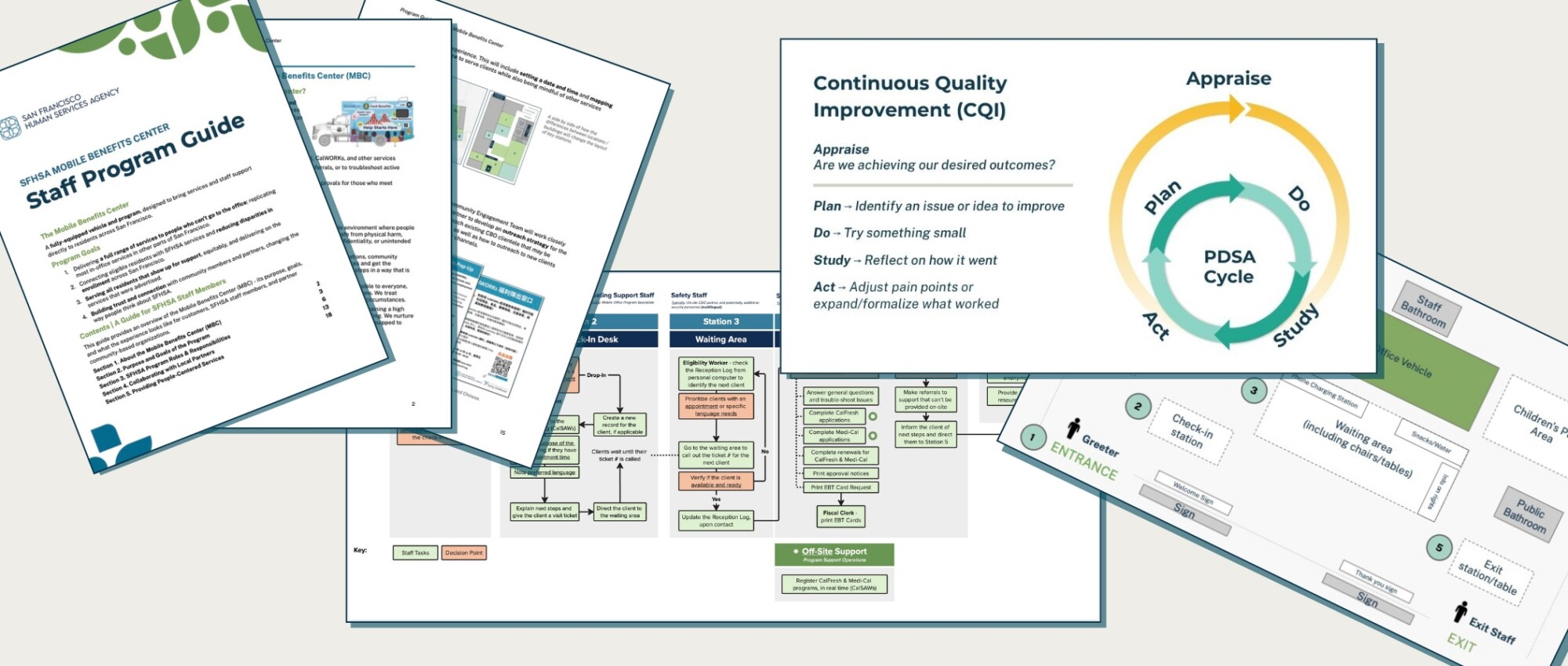
One category of prototypes were the internal program artifacts that could be used to manage and evaluate the program, including:
- Service Blueprint/Service Delivery Map. Compiled an overview of the program, its core activities mapped across different client stages in the process.
- Site Map. Developed conceptual site layouts illustrating potential configurations for staff, equipment, service stations, and client flow at Mobile Benefits Center events. These planning tools supported operational planning and helped the team adapt prototype events to different community partner locations and physical site constraints.
- Event Checklist. Prepared a spreadsheet that outlined steps to prepare for an event with a community-based partner. The checklist covered: scoping, outreach, preparation, the day of the event, and after the event. This list was used and refined during full-service prototype events that we conducted later.
- Exit Survey. Designed a questionnaire to explore participant satisfaction and experience after attending a Mobile Benefits Center event.
- Program Guide. Assembled an overview document of the Mobile Benefits Center – detailing its purpose, goals, and what the experience looks like for customers, SFHSA staff members, and partner community-based organizations. One program guide was designed for SFHSA team members that would staff the event, and another for potential CBO partners.
- Continuous Quality Improvement (CQI) Framework. Outlined a structured way for the Mobile Benefits Center team to evaluate and improve the program over time. Collaborated with staff members to define goals, metrics, and a cadence for evaluation.
Several of these prototypes were developed and tested early in our prototyping phase, but also continued to be referenced and refined as we ramped up to in-field prototypes.
Prototypes of Outreach & Design Elements
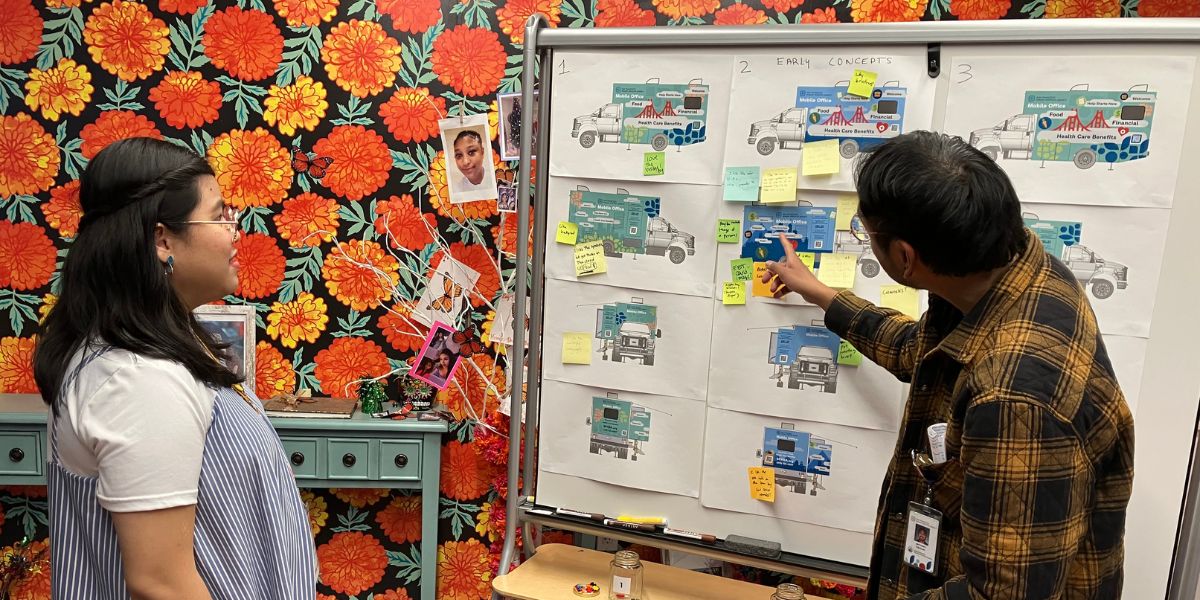
Another category of prototypes were outreach materials & design elements, developed in close collaboration with the SFHSA Communications Team:
- Website Considerations. Prepared layout and content considerations for the website, both for the general public and for potential community partners.
- Vehicle Wrap Concept Testing. Helped translate insights from the discovery phase into a vehicle wrap design, sharing considerations with the graphic designer on the SFHSA Communications Team. Designed an approach for the SFHSA Team to invite feedback from community members and CBO partners.
Prototypes of Service Delivery
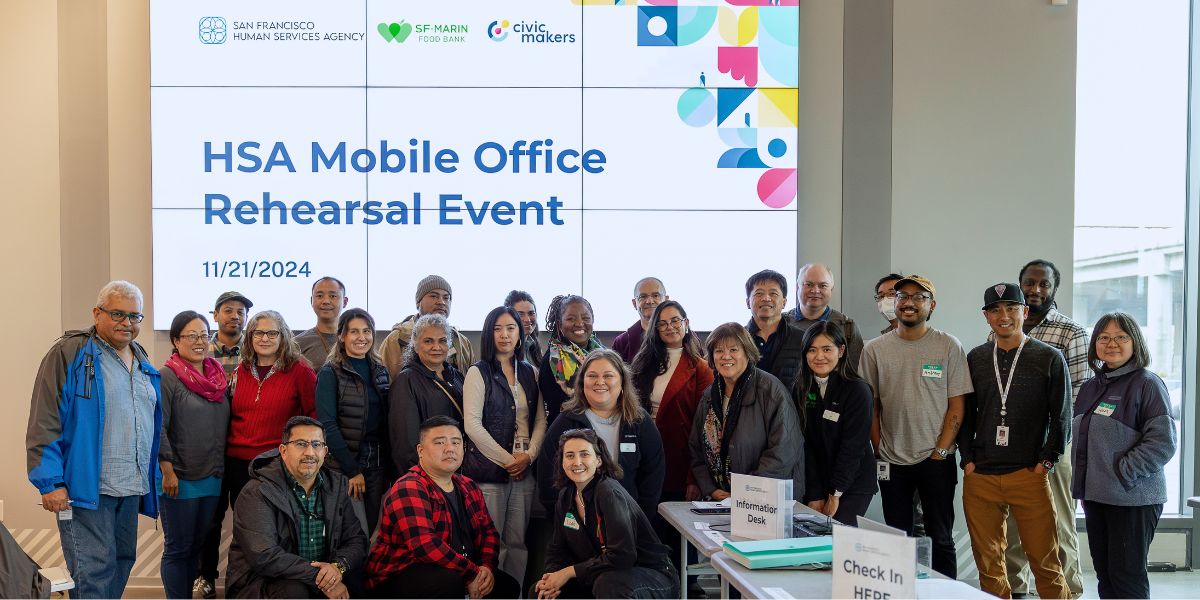
The last category of prototypes were the in-person tests of the service flow and experience.
SFHSA already had experience deploying outreach teams into the community to connect people with services, but the Mobile Benefits Center introduces a new level of on-site service delivery capability. This meant bringing more traditionally office-based staff and functions into the field. We wanted to ensure those team members were included throughout the process and had the opportunity to help shape the experience for both clients and staff.
- Rehearsal Event with Staff. Welcomed over 20 staff members from across SFHSA and SFMFB to test early versions of the program design to gather input and ensure staff feel fully supported to deliver services in the field.
- In-Field Events with Clients. Integrated all our learnings into two Mobile Benefits Center pilot events. These events tested several elements of the program (e.g. the event checklist, the on-site layout and set-up process, the client flow through stations) – but most importantly, we tested the program experience for the clients, CBO staff, and HSA staff members that would be involved.
“I think this pop-up is a great idea – I’ve been trying to get EBT set-up for a while but it’s complicated without help. Y’all should make this a recurring event.”
– Client
“[Youth] came up to me jumping for joy because they got approved for Medi-Cal and CalFresh. Someone came up to me and said they were going to get their benefits stopped, but when talking to staff, it turned out it was an error. So just seeing the relief in their faces was great.”
– CBO Partner
“[Greatest value from the event was] being able to assist these clients. They had pending applications or had to renew, so I’m glad we were able to assist.”
– SFHSA Staff Member, Eligibility
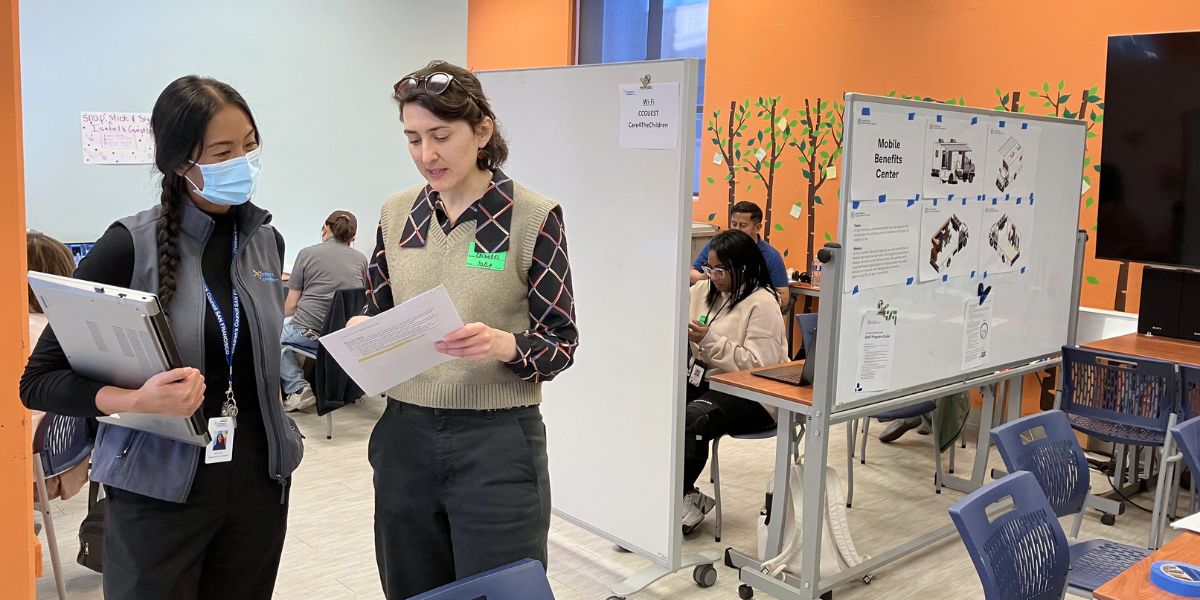
To meaningfully learn from these prototypes, we defined key audiences, research questions, and data collection methods to assess their effectiveness and continuously improve. We viewed each prototype as an opportunity to make this program tangible. Our goal was always to build something deeply-rooted on the input we’d gathered, testing and improving each prototype alongside the project team so that they had equal ownership of these living resources.
By the time we reached the In-Field Rehearsal Events with benefits recipients, the project team became full project managers – using the artifacts we had built to collaborate with CBO partners and coordinate event logistics and service delivery. Our role shifted to provide support and outside evaluation – handing off continuous improvement to the very staff that would be leading this program going forward.
In April 2026, we had the opportunity to see the new vehicle in person and join the ribbon cutting for the program. We’re so grateful to have been part of this journey, and to know that we could help establish the foundational components of the program – in collaboration with those who will be visiting or staffing its events.
We are beyond excited to see this initiative – that we’d seen in draft format for so long – take to the streets and help residents across San Francisco!
“CivicMakers was a thoughtful, detail-oriented partner in developing our Mobile Benefits Center program. Their tools, checklists, and hands-on support were critical in shaping prototype rehearsal events and will continue to inform future real-world deployments. They were wonderful teammates and we were genuinely sad to see them go.”
Ana Marie Lara Community Engagement & Quality Assurance Manager, SFHSA